Learning to talk while crying

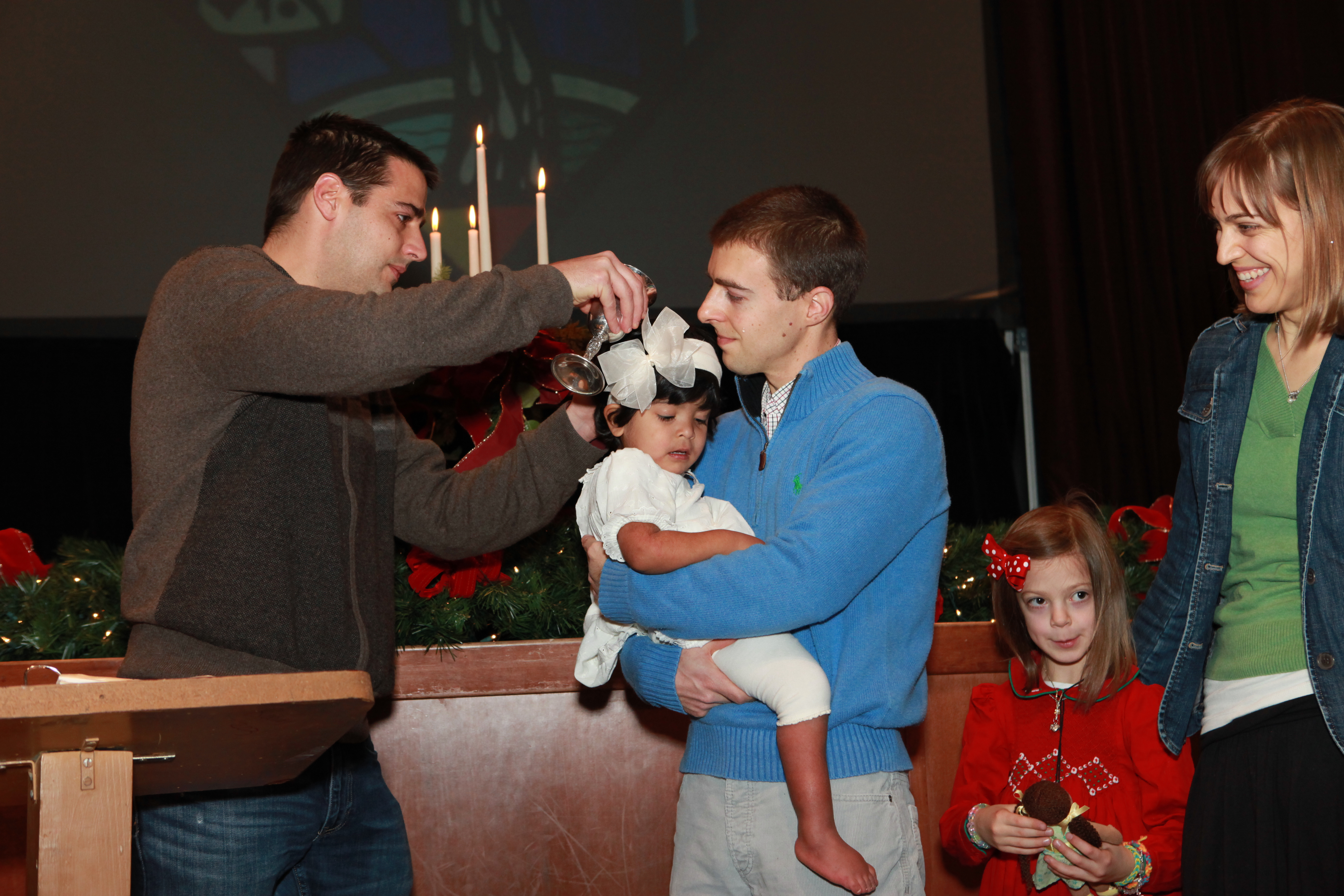
IMG_9724As we talked through last Sunday’s service Rachel mentioned, with tact and gentleness and grace, that I need to learn how to talk while I cry.  This was not an issue when we got married, or when I began preaching, because I did not cry then.  She knows something about this, so we talked about strategery.

For those in attendance especially, I did not cry on Sunday because our family is  leaving.  I cried because, as a pastor and friend, I prayed for this little girl when she was in the hospital.  Maybe twice.  Maybe before that even.  And, to pronounce the promises of Jesus over her is powerful.  When practicing that morning I could not keep from crying.  When Baptizing her I could not stop.  The promises, the life, the abundant blessings overwhelm me in their goodness.

I talked about the way Riverside does Baptisms (it should be a class in seminary; we do it really well).  I said that Baptism is a sign and a seal on Lily, and we all look forward to hearing her profess her faith in Christ in the coming years.  I asked the Darr’s if they trust Jesus with her, and if they will lean on the church when they need to.  They said (you probably heard this part), “By God’s Grace we do.”  I asked the church if they would support with love and love, and they said, “By God’s Grace we will”.

Then I said to Lily, “For you Jesus Christ came into the world.  For you He lived and showed God’s love.  For you he suffered the darkness of the cross and cried, “It is finished.”  For you he triumphed over death and rose to new life.  For you he reigns at God’s right hand.  All this he did for you, though you do not know it yet.”  For the most part, it is a quote from Wayne Larson, a Scottish Pastor who did the Royal Baptism recently.  I changed some things because I wanted to, but the last part is so well said that I wanted to make sure I credited him.

I’m not sure people could hear me this past week because of my tears.  Sorry Riverside folk!

I love my ‘job’.

Jesus on Anxiety

teaching

This past week I preached on this text as part of our “InstaJesus” Series:

Therefore I tell you, do not be anxious about your life, what you will eat or what you will drink, nor about your body, what you will put on. Is not life more than food, and the body more than clothing? Look at the birds of the air: they neither sow nor reap nor gather into barns, and yet your heavenly Father feeds them. Are you not of more value than they? And which of you by being anxious can add a single hour to his span of life? And why are you anxious about clothing? Consider the lilies of the field, how they grow: they neither toil nor spin, yet I tell you, even Solomon in all his glory was not arrayed like one of these. But if God so clothes the grass of the field, which today is alive and tomorrow is thrown into the oven, will he not much more clothe you, O you of little faith? Therefore do not be anxious, saying, ‘What shall we eat?’ or ‘What shall we drink?’ or ‘What shall we wear?’ For the Gentiles seek after all these things, and your heavenly Father knows that you need them all. But seek first the kingdom of God and his righteousness, and all these things will be added to you.  Therefore do not be anxious about tomorrow, for tomorrow will be anxious for itself. Sufficient for the day is its own trouble. Matthew 6:25-34

There is so much in this text!  But, I want to say one thing about it today: every text in the New Testament assumes that people have anxiety.  And every text assumes we can be free of it.

When we jump too quickly into the commands (and there are 6 in this short passage), we miss the assumption.  Similarly, in Paul’s letter to the Philippians, if we miss the fact that Paul assumes we are anxious, we can jump too quickly into ‘what we do about it’.  Men and women feel enough shame for their anxiety.  I know I do.  Peter assumes that many of the followers of Jesus are anxious; why else would he write “cast your anxieties upon Him”.

Jesus assumes men and women are anxious.  So does Paul.  So does Peter.

I’m going to stop there, because hearing this one thing is important.

The one author I always recommend

I wanted to say, “the best Christian author”, or “the most helpful”, or something even more final, but that would be less true.  

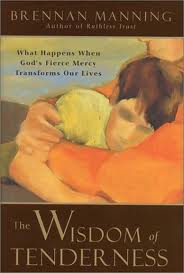
Since I was around 19, my answer to “Who is your favorite Christian author” has always been: Brennan Manning.  

He died last Friday and I am glad for the LORD and sad for the rest of us.  Donald Miller wrote, very beautifully and helpfully in my opinion, here.

I like a lot of authors.  My favorite regular writer is Andre Dubus.  John Eldredge and John Piper were especially helpful around the same time I started reading Brennan Manning.  But, most authors have some kind of agenda, niche, or cultural role that they play – Christian or otherwise.  Manning wrote well, personally, specifically, beautifully; about the grace of Jesus.  

In the acclaimed biography of Steve Jobs I remember reading, after he left Apple, that many people were sad because “He made the first computer people weren’t scared of”.  In an age where Christianity is often scary or weird or irrelevant (for valid reasons each); Manning speaks of the real Jesus.  Who is scary, but good.  Weird but delightfully, humanly, powerfully so.  And the most relevant human who ever lived.

I was in a college Sunday School class when a teacher (Methodist teacher; Manning is Catholic) urged us, repeatedly and with passion, to read the Signature of Jesus.  So I did.  Then I read Abba’s Child, etc.  A very good friend and mentor references The Relentless Tenderness of Jesus in almost every conversation we have.  Last year I bought Abba’s Child for a friend with serious addiction issues and then I re read it myself and periodically wrote to her about what I was enjoying about the book.  Two years ago a friend with anxiety and I read the Importance of Being Foolish.  My old pastor quoted Manning regularly, “I’m like an angel with an incredible capacity for beer.”

Image

I will miss his books.  I hope to finish reading them and to then set them next to Dubus’, who would’ve loved Manning.  I hope to love and be loved as he did – only I hear Manning chuckling and reminding me that His Grace is sufficient for me, His pursuit wilder than I can imagine, and His love would overwhelm me if it came on any stronger!

Why do we give our Kid’s Leaders the hardest Bible Texts?

images


A few weeks ago my job description changed to include the kid’s ministry on Sunday mornings, and it has been a sharp learning curve!

This Sunday our kids will be looking at a very cool and very difficult-for-2013-ears story: Achan’s sin.

I am thrilled that our curriculum locates the story well in God’s plan.  While the penalty for sin is death, and many people in this story die, we are blessed to know that Jesus paid that price for us.  I am doubly thrilled that we have curriculum that also doesn’t shy away from reminding us that the penalty is death.

One way of summing up the Good News of God is that the penalty is death.  God, in his great mercy, saved us from that in Jesus (those He calls, who trust Him with their hearts and decisions).  God then offers us new life in Him and this is Grace (the thing we didn’t earn).

I think our culture receives the grace part well – free, generous gift from God.  Cool.  This is unique too, I’m not sure that people were as as good at receiving 50-60 years ago.  But, in 2013 we are uncomfortable with the gap between the world as we know it, and the world God originally made.

Shying away from texts like this will lead us to forget God’s holiness.  And, sadly, if we do that then the gift of Jesus’ grace all but disappears.


Lent(en) Devotionals

ImageEvery year I plan to read devotionally for lent.  Some years i do better than others.

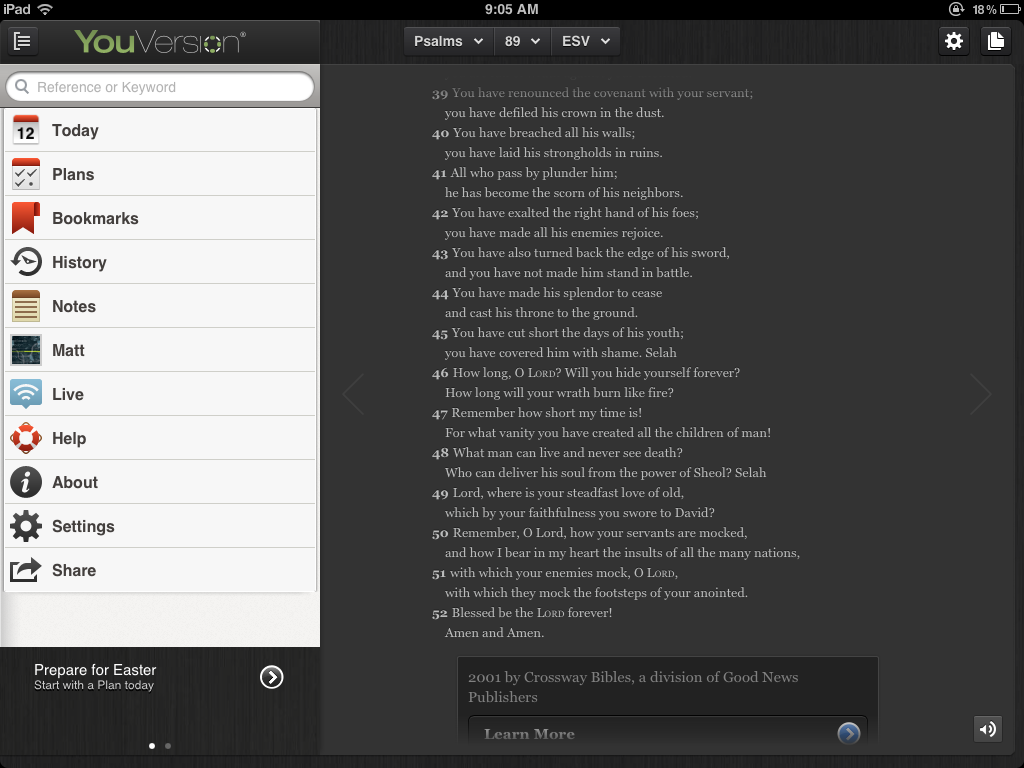
If you have the Bible App (Holy Bible) from Word Press, there are several good options for reading this Lenten season if you want them.

When you open the App, there is a button on the bottom left “Prepare for Easter”.

Image

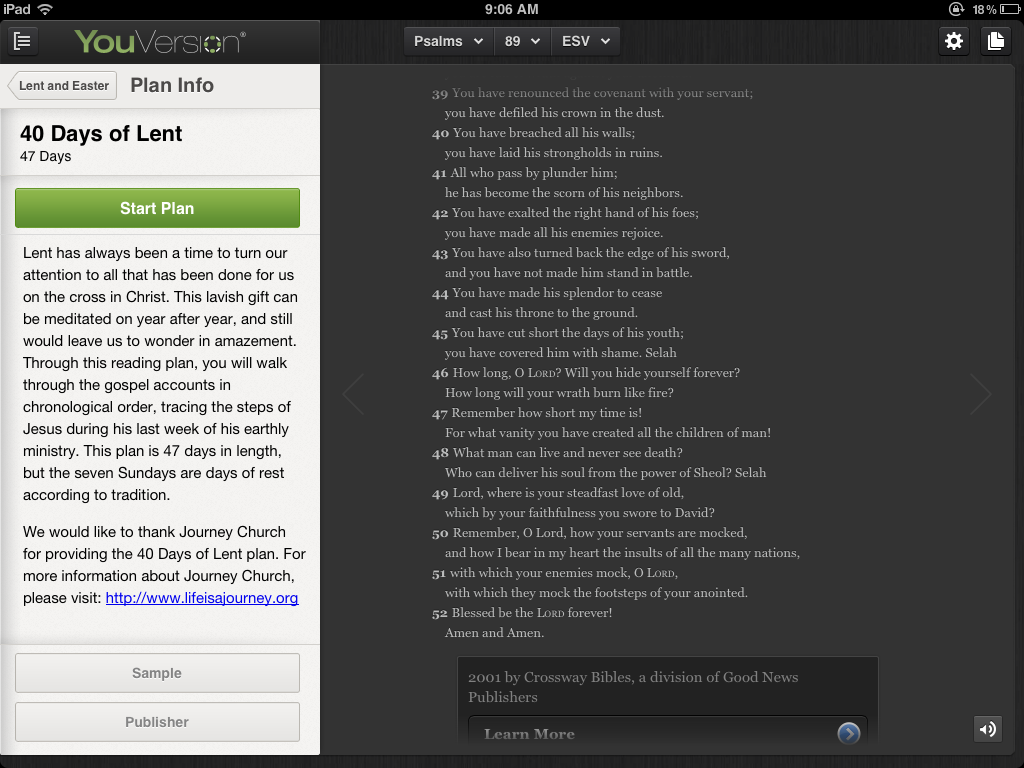
Then, you can pick one of their 4 Devotions.  Lent for everyone is by one of the foremost New Testament Scholars alive, who is also passionate about the accessibility of the Bible.  I picked 40 Days of Lent for a variety of reasons.

There are other options out there, but I wanted to mention four.

And lastly, if you fast from anything, don’t tell anyone 🙂  And, if you do one of these devotionals, resist the urge to “Share” it.  Image

Image

The Forgotten Mentor: Morris Passmore

Unknown

A few years ago I wrote about my mentors.  Mostly men, family, a few bosses, etc.

I did not include my Spanish teacher from 9-12th grade.  In many ways he was the most important of all of them.  How then, could I forget to write about him?  It was because I need to continue to think and re-think about this question.  It is inherently a humbling question, and I am certainly more humbled (not humble maybe) than I was when I began writing.

My high school was a strange place.  I won’t go into it here, but it was hard to be a Christian there and it was a Christian institution.  My Spanish teacher, Mr. Passmore, was loved by all.  But, he did not tolerate all, he did not enable, he was a good teacher, and as a strong man he was clear when he thought you were crossing the line or hurting yourself with your actions.

At a time when I was well-nigh intolerable he tolerated me; he tolerated me.  And, he loved me.  When it was possible anyway.

Mr. Passmore called us Dufflepuds.  A Narnian reference.  He also knew martial arts, and once, when I tried to scare him, I found myself on my back with no wind in my body.  He always smiled, unless he was deeply sad over our stupidity, lack of respect, or our general ignorance of the Grace of Jesus and how we live in light of it.

He regularly did devotionals and I remember a number of them.  It has been 20 years and I can still hear his voice.  He once pointed out how little we remember, understand, or care about the trinity.  I doubt I can accurately describe how little we thought we cared about this as he began (picture 15 year olds in uniforms, allowed to sit on the floor).  The devotional was on John 10:30, “I and the Father are one.”  That is how good he was/is.  I could also ask and answer 50 questions in full spanish pretty easily by the end of the semester.

My friend Fiek and I bought a file cabinet our senior year and left in in his room.  We put a Spanish Curse-Phrase on the top of it.  He read it, laughed, sent us along, and later re-made the phrase into a less-inflammatory one.  Grace, but without enabling.

I am unsure of how deeply the Holy Spirit used his mentoring to save/grow/maintain my heart, but I know that he is as important of a mentor as I have had.  Kris Cooper is the other who I think of regularly, but as I get older I notice how the younger years were sustaining, protecting years.  Mr. Passmore (Lieutenant Passmore) was there, he was consistently loving without putting up with our BS.  I am deeply grateful.

A few days ago I googled him (for about the 10th time in as many years) and found his email address.  I’m writing this because I am thrilled to reconnect with him.  I might not see or hear from him or his family for awhile (not really anyway), but I will never (and I mean that in the eternal sense) forget his mentoring.

The most passionate devotional I recall him giving was on Colossians 1:27, “Christ in you, the hope of Glory”.  Similarly, to the John 10:30 passage, I am still in awe that the Holy Spirit would use a man so mightily.  I can  hear the energy in his voice, the shock, the joy that we are called into this mission with Christ!  It is still a humbling verse/truth/devotional to me.

I will be preaching at Riverside tomorrow.  I cannot imagine that I would be there if the Lord had not led him into my life.

Thank you sir.  For everything.


My Adolescence Exposed

Last week Riverside’s lead pastor, Zack Eswine, taught the first part of a class on Parenting Teens.

Here is his summary:

Talking together about our common joys, pains and quandaries as parents was encouraging.  We are in this together and are not alone.
We framed our discussion by saying four things:
1. Adolescence in our kids changes our position from insiders to outsiders
2. This means we are no longer viewed as heros but are put into the position of being undervalued and overlooked
3. Our avenues of love are reduced during this season. More positively, unconditional love comes to the forefront.
4. Encountering adolescence in our kids often acts like a mirror to the remaining immaturities that still exist within us.
Wow! Is there hope for the outsider who is overlooked who struggles to love and who is full of their own immaturity? Yes! There is hope in Jesus. The same gospel that our teens need we ourselves need too.
We also said that rules really matter. But the way we interact with the rules mattters just as much. In addition, there may come a time when the rules don’t work anymore. When that happens we are forcefully reminded that we are not in control. Ultimately then, our goal isn’t to control the way our kids behave but instead to enable them to experience over and over again what it feels like to relate with a Jesus oriented adult. At this point our way of life speaks as much as our the words we’ve always used up to that point.
May I strongly recommend a little book entitled, Dew for your Youth by Eugene Peterson? The chapters are very short but very practical and gospel oriented.

What I Miss in the Walking on Water Story

Jesus dismissed his disciples – so he could pray.

He dismissed a crowd – so he could pray.

He apparently prayed for a long time (between 3-6 AM is when he re-joined the disciples according to The ESV Study Bible, which is so huge I assume it knows).  He didn’t always pray for a long time (Lazarus Story).

Lord, please help me take seriously your promise to repay me if I will just get alone and pray to you the way you encouraged.

Vengeance Disintegrates You

There are two quotes I want to use tomorrow, but I don’t like using quotes.  🙂

When I listen to someone I tune out when they quote someone.  Almost always.  I know not everyone is like this.  I don’t like that I am.  But, it is still true.  If a preacher who I listen to references someone over and over I will eventually start reading the author or listening to the preacher.  Both of my quotes are from books I read because they were repeatedly quoted and encouraged towards me.  Since I could hear, christians have been referencing CS Lewis, and since I have been in St. Louis I hear about Tim Keller (which was before he was Tim Keller).  

So, I will likely paraphrase these tomorrow, giving credit, floundering a bit, but not quoting.

Keller on Forgiveness, from King’s Cross, “One thing you can do is to try and make that person pay: You can try to destroy their opportunities or ruin their reputation; you can hope they suffer, or you can actually see to it.  But, there’s a big problem with that.  As you’re making them pay off the debt, as you’re making them suffer because of what they did to you, you’re becoming like them.  You’re becoming harder, colder; you’re becoming like the perpetrator.  Evil wins.  What else can you do?

The alternative is to forgive.  But there’s nothing easy about real forgiveness.  When you want to harbor vengeful thought, when you want so much to carry our vengeful actions but you refuse them in an effort to forgive, it hurts.  When you refrain, when you forgive, it’s agony.  Why?  Instead of making the other person suffer, you’re absorbing the cost yourself.  You aren’t trying to get your reputation back by tearing their reputation down.  You are forgiving them and it is costing you.  That’s what forgiveness is.  True forgiveness always entails suffering.

So the debt of wrong doesn’t vanish: Either they pay or you pay.  But here’s the irony.  Only if you pay the price of forgiveness, only if you absorb the debt, is there any chance of righting the wrong.  If you confront somebody with what they’ve done wrong while you’ve got vengeance in your heart, they probably won’t listen to you.  They’ll sense that you are not seeking justice but revenge, and they’ll reject anything you say.  You’ll just perpetuate the cycle of retaliation, retaliation, retaliation.  Only if you have refrained from vengeance and paid the cost of forgiveness will you have any hope of getting them to listen to you, of seeing their own error.  And even if they do not listen to you at first, your forgiveness breaks the cycle of further reprisals.”

Lewis on why it is important, “This does not mean that we are to be perpetually solemn.  WE must play.  But our merriment must be of that kind (and it is, in fact, the merriest kind) which exists between people who have, from the outset, taken each other seriously – no flippancy, no superiority, no presumption.  And our charity must be a real and costly love, with deep feeling for the sins in spite of which we love the sinner – no mere tolerance, or indulgence which parodies love as flippant and parodies merriment.  Next to the Blessed Sacrament itself, your neighbor is the holiest object presented to your senses.  If he is your Christian neighbor, he is holy in almost the same way, for in him also Christ here latitat – the glorifier and the glorified, Glory Himself, is truly hidden.”

Good Luck me.


Why Your Family Can’t Decide Where to Eat

CS Lewis thought his writing wouldn’t make it 5 years after he died.  The reason so many continue to quote him is that he got to the point, and usually did it with incisiveness but also in a way that is light enough to accept.  Almost every day I read something of his I return home wanting to talk about it – often laughing at how ridiculous I am.  Pointed out to me by strange fictitious allegories of Lewis’.

In the Screwtape Letters, a letter from an older demon to a younger, he writes this about families.  I think this account is still remarkably accurate.  You?

“In discussing any joint action, it becomes obligatory that A should argue in favor of B’s supposed wishes and against his own, while B does the opposite.  It is often impossible to find out either party’s real wishes; with luck, they end by doing something that neither wants, while each feels a glow of self-righteousness and harbors a secret claim to preferential treatment for the unselfishness shown and a secret grudge against the other for the ease which the sacrifice has been accepted.  Later on, you can venture on what may be called the Generous Conflict Illusion.  This game is best played with more than two players, in a family with grown-up children, for example.  Something quite trivial, like having tea in the garden, is proposed.  One member takes care to make it quite clear (though not in so many words) that he would rather not but is, of court, prepared to do so our of “Unselfishness”.  The others instantly withdraw their proposal, ostensibly through their “Unselfishness” but real because they don’t want to be used as a sort of lay figure on where the first speaker practices petty altruisms” (I had to read that one twice…  it is worth catching though!).  “But he is not going to be done out of his debauch of Unselfishness either.  He insists on doing “what the others want”.  They insist on doing what he wants.  Passions are roused.  Soon someone is saying “Very well then, I won’t have tea at all!”  And  a real quarrel ensues with bitter resentment on both sides.  You see how it is done?  If each side had been frankly contending for its own real wish, they would all have kept within the bounds of reason and courtesy; but just because the contention is reversed and each side is fighting the other side’s battle, all the bitterness which really flows from thwarted self-righteousness and obstinacy and from the accumulated grudges of the last 10 years is concealed from them by the nominal or official “Unselfishness” of what they are doing or, at least, held to be excused by it.  Each side is, indeed, quite alive to the cheap quality of the adversary’s Unselfishness and of the false position into which he is trying to force them; but each manages to feel blameless and ill-used itself; with no more dishonesty than comes natural to a human.”